US Income Tax Estimator
This income tax calculator estimates your 2024 US federal income tax. Federal income tax is widely misunderstood because marginal brackets are widely misunderstood: earning more never makes you worse off, because each rate applies only to the slice of income inside its bracket. This estimator does the real calculation for the 2024 tax year — subtracting your deduction, then taxing your income slice by slice through the genuine IRS brackets for single filers or married couples filing jointly — and shows your total tax, your effective rate and your marginal rate.
US Income Tax Estimator
Estimate 2024 federal income tax using the real IRS brackets.
Your result
Formula
Taxable income = income - deduction. Tax is charged slice by slice through the 2024 federal brackets (10%, 12%, 22%, 24%, 32%, 35%, 37%).
How to use this calculator
Enter your income, filing status and deduction (the standard deduction is pre-filled for single filers).
Worked example
Example: €85,000 single with the €14,600 standard deduction gives taxable income of €70,400 and about €10,541 federal tax.
Frequently asked questions
US Income Tax Estimator
Use this income tax calculator to estimate a refund or a bill before filing, to understand what a raise or a bonus will actually add after federal tax, or to get the realistic federal percentage that the Paycheck Calculator asks for. This income tax calculator covers federal income tax only: Social Security and Medicare payroll taxes (7.65% for most employees), state taxes and credits are separate and will raise your total further.
Formula
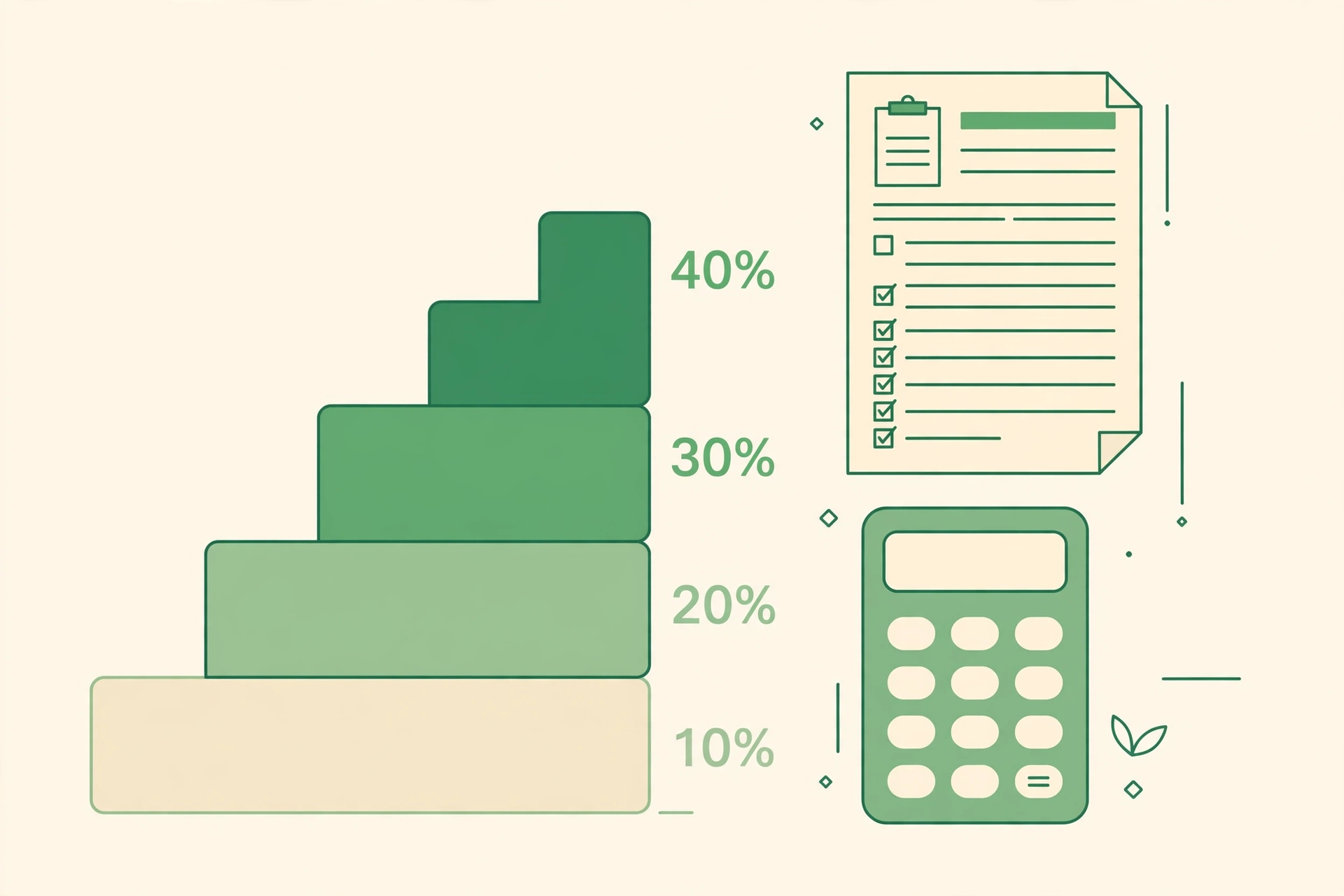
Taxable income = gross income − deduction. Tax is then charged in slices: 10%, 12%, 22%, 24%, 32%, 35% and 37% brackets for 2024, with thresholds depending on filing status.
Your effective rate — total tax divided by total income — is always lower than your marginal rate, which is the rate on your next dollar earned. This income tax calculator shows both rates for the figures you enter. The 2024 standard deduction is $14,600 for single filers and $29,200 for married filing jointly, and it is pre-filled for single filers in this calculator; change it if you itemise or have adjustments to income.
How to use this calculator
Enter your gross income into the income tax calculator, choose your filing status — single, or married filing jointly — and confirm the deduction amount. The income tax calculator shows your taxable income, the federal tax owed, your effective tax rate and your take-home pay after federal tax. Update the deduction if you itemise deductions above the standard amount.
Worked example
Using this income tax calculator, a single filer earning $85,000 with the $14,600 standard deduction has taxable income of $70,400 and owes about $10,541 in federal income tax — an effective rate of about 12.4%, even though their marginal bracket is 22%.
A practical tip before you act on any result: run this income tax calculator twice, once with the figures you hope are true and once with more cautious figures — a slightly higher rate, a slightly lower return, or a slightly shorter timescale. If the decision still looks sound under the cautious version, it is probably a robust one. If it only works under the optimistic version, the honest conclusion is that the plan, not the calculator, needs adjusting before you commit any money.
How This Income Tax Calculator Applies 2024 Federal Tax Brackets
The United States taxes income in slices, not all at once. For 2024, single filers pay 10% on the first $11,600 of taxable income, 12% on the slice from $11,601 to $47,150, 22% up to $100,525, 24% up to $191,950, 32% up to $243,725, 35% up to $609,350, and 37% above that. Married couples filing jointly get roughly double these thresholds. This income tax calculator runs your taxable income through each slice in turn, so only the dollars inside the top bracket face the top rate.
That slice-by-slice math is why a raise can never reduce your take-home pay: moving into the 22% bracket means only the income above $47,150 is taxed at 22%, while everything below keeps its lower rates. Your marginal rate is the rate on your next dollar; your effective rate is total tax divided by total income, and it is always lower. The income tax calculator shows both figures so you can see exactly what a bonus, a raise, or extra freelance income will cost you in federal tax.
Standard Deduction vs Itemized Deductions
Before brackets apply, your deduction shrinks the income that gets taxed — and this income tax calculator subtracts it before applying the bracket rates. For 2024 the standard deduction is $14,600 for single filers and $29,200 for married couples filing jointly, a flat amount you can claim with no receipts. Itemizing means listing actual deductible expenses instead: state and local taxes (capped at $10,000), mortgage interest, and charitable donations are the big three. You take whichever is larger, and about nine in ten taxpayers come out ahead with the standard deduction.
Itemizing wins when your deductible expenses clear the standard amount — common for homeowners with large mortgages in high-tax states, or anyone who gave generously to charity. Keep records either way: if you are close to the line, running the numbers both ways shows which choice lowers your bill. Note that the deduction field here is pre-filled with the standard amount, so adjust it if you plan to itemize.
Federal vs State Income Tax
This income tax calculator covers federal income tax only, which is just one layer. Forty-one states levy their own income tax, with top rates ranging from under 3% to over 13% in California, and several cities — including New York City — add local income tax on top. Nine states have no broad-based income tax at all: Alaska, Florida, Nevada, South Dakota, Tennessee, Texas, Washington, and Wyoming, plus New Hampshire, which taxes only interest and dividend income.
State rules differ wildly: some states start from your federal adjusted gross income, while others have their own brackets, deductions, and credits. Moving across a state line can change your total tax bill by thousands even with identical earnings. So treat this income tax calculator as the federal layer of your planning, then add your state’s estimate and the 7.65% payroll tax most employees pay to see the full picture.
Tax Credits That Lower Your Bill
Deductions shrink the income you are taxed on; credits shrink the tax itself, dollar for dollar, which makes them more powerful. The Child Tax Credit offers up to $2,000 per qualifying child for 2024. The Earned Income Tax Credit helps low- and moderate-income workers and can be worth several thousand dollars. Education costs bring the American Opportunity Credit (up to $2,500 per student for the first four years of college) and the Lifetime Learning Credit for ongoing study.
Some credits are refundable, meaning they can push your refund above what you paid in; nonrefundable credits can only reduce your tax to zero. Because this income tax calculator estimates tax before credits, your actual bill could be lower — sometimes much lower. The IRS keeps the full list of current credits and deductions for individuals, and it is worth checking which ones match your situation before you file.
Quarterly Estimated Taxes for Freelancers
Employees have tax withheld from every paycheck, but freelancers, contractors, and landlords must send the IRS money four times a year through estimated tax payments. You generally owe them if you expect to owe $1,000 or more after withholding and credits. An income tax calculator is the simplest way to estimate each quarterly payment: project your annual income, compute the federal tax, and divide by four. The deadlines are 15 April, 15 June, 15 September, and 15 January, and missing them triggers underpayment penalties even if you pay in full at filing time.
The safe harbor rule keeps you penalty-free: pay at least 90% of this year’s tax or 100% of last year’s tax (110% if your income topped $150,000). Freelancers also owe 15.3% self-employment tax on top of income tax, so set aside 25–30% of each payment you receive. Re-running your projected income through the calculator each quarter turns a guessing game into a planned transfer.
Common Tax Filing Mistakes to Avoid
The most expensive mistakes are avoidable. Filing under the wrong status — for example, filing as single when head of household would cut your bill — is common after a divorce or a new baby. Forgetting a 1099 for freelance or interest income invites an IRS notice, since the agency receives copies too. Simple math errors and transposed Social Security numbers still delay thousands of refunds every year.
Other classics: forgetting to sign and date a paper return, missing the April deadline without filing an extension, and never updating your W-4 withholding after a raise, marriage, or new child — which produces a nasty surprise or a giant interest-free loan to the government. A quick pre-filing run through an income tax calculator with this year’s figures catches most of these problems while there is still time to fix them.
Frequently asked questions
Does this include state tax and payroll tax?
No. It estimates federal income tax only. Most employees also pay 7.65% in Social Security and Medicare taxes, and most states levy their own income tax on top, so your total tax will be higher than the figure shown here.
Is this calculator tax advice?
No. It is a planning estimate based on the published 2024 brackets and the figures you enter; it does not model credits, adjustments or special income types. Use IRS.gov or a qualified tax professional to prepare an actual return.
How accurate is this income tax calculator?
It applies the published 2024 IRS brackets and the standard deduction to the figures you enter, so the federal estimate is exact for straightforward wage income. Credits, adjustments, and special income types are not modelled, so treat it as a planning figure, not a filing figure.
What is the difference between a tax credit and a tax deduction?
A deduction reduces the income that gets taxed, saving you a fraction of its value at your marginal rate. A credit reduces your tax bill dollar for dollar, so a $1,000 credit saves you a full $1,000. Credits are almost always the better deal.
Do I need to pay quarterly estimated taxes if I am self-employed?
Usually yes. If you expect to owe $1,000 or more after any withholding, the IRS wants payment in four instalments through the year. Paying at least 90% of this year’s tax, or 100% of last year’s, keeps you clear of underpayment penalties.
What happens if I file my tax return late?
The failure-to-file penalty is 5% of unpaid tax per month, up to 25%, plus interest. If you cannot file on time, submit Form 4868 for an automatic six-month extension — but note the extension covers filing, not paying. Pay what you owe by April to stop penalties growing.
Can I still get a refund if my income is very low?
Yes. Refundable credits such as the Earned Income Tax Credit and part of the Child Tax Credit can produce a refund even when you owe no tax. Filing a return is the only way to claim them, so file even if your income is below the filing threshold.
Related calculators
Mortgage Calculator · Compound Interest Calculator · Loan / EMI Calculator