What Is Inflation Doing to Your Money? How to Calculate It
What is inflation doing to your money? It is the quietest tax there is. No bill arrives, no account is debited — yet every year, your dollars buy a little less than they did before. Understanding inflation and your money is one of the most important financial skills you can build, because inflation touches everything: your savings, your salary, your investments, and your retirement plans. In this guide, you will learn exactly what inflation is, how it erodes purchasing power over time, and — most importantly — the practical steps you can take to protect your wealth.
What Is Inflation
Inflation is the general rise in prices across an economy over time. When inflation runs at 3%, something that costs $100 today will cost about $103 next year. It is not that the item became more valuable — it is that each dollar became slightly less valuable. Inflation is measured as a percentage rate, usually reported year over year.
In the United States, the most widely cited measure is the Consumer Price Index (CPI), published by the U.S. Bureau of Labor Statistics. The CPI tracks the prices of a representative basket of goods and services — housing, food, transportation, medical care, and more — to gauge how the cost of living changes. When you hear that “inflation was 3.2% last month,” that figure almost always comes from the CPI.
A little inflation is considered normal and even healthy. The Federal Reserve targets about 2% annual inflation, as explained in the Federal Reserve’s own guidance. At that pace, prices double roughly every 35 years — slow enough that the economy can adjust, but a reminder that cash sitting idle is always losing ground.
How Inflation Erodes Money
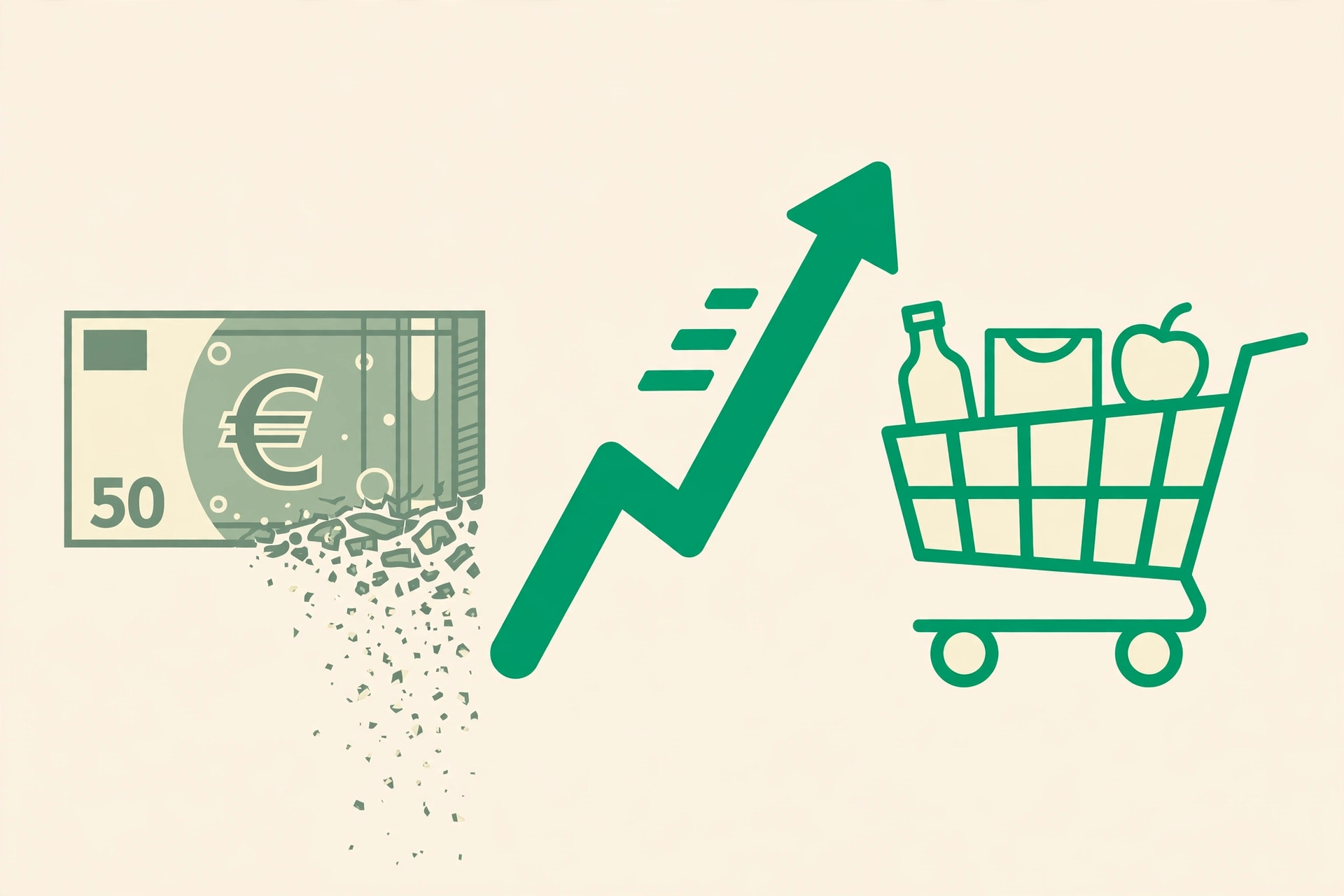
Inflation erodes money by shrinking purchasing power — what each dollar can actually buy. If your savings earn 1% interest while inflation runs at 3%, your account balance grows on paper, but you can afford less with it than a year earlier. Your real return is negative, even though the nominal number went up.
The formula for future purchasing power is straightforward:
Future purchasing power = Amount ÷ (1 + inflation rate)years
Take $10,000 in savings with 3% annual inflation. After 10 years, its purchasing power is $10,000 ÷ (1.03)10 = $7,441. After 20 years, it is just $5,537. Your money did not move, yet a quarter of its value evaporated in a decade. Try your own numbers with the free Inflation Calculator to see the effect on your savings.
This is why economists call inflation a “quiet tax.” Unlike income tax, there is no form to file and no refund to claim. The loss happens silently, a fraction of a percent each month, compounding year after year. The longer your time horizon, the more devastating the erosion — which is why understanding inflation and your money matters most for long-term goals like retirement.
Historical Examples
History offers vivid lessons in what inflation does to money. The most famous case is 1970s America, when inflation averaged over 7% for a decade and peaked above 13%. Workers demanded cost-of-living raises, businesses raised prices to cover wages, and the cycle fed on itself. Savers who kept cash in low-interest accounts watched their purchasing power collapse, while borrowers with fixed-rate mortgages saw their debts shrink in real terms.
More recently, the 2021–2023 inflation surge reminded everyone that price stability is not guaranteed. After years of sub-2% inflation, U.S. CPI inflation topped 9% in mid-2022, driven by supply-chain disruptions and strong demand. Groceries, rent, and used cars jumped in price within months. Households that had no inflation plan suddenly felt poorer, even with unchanged paychecks.
The extreme case is Weimar Germany in the 1920s, where hyperinflation made currency effectively worthless — people carried wheelbarrows of banknotes to buy bread. That scenario is extraordinarily unlikely in a modern developed economy, but it illustrates the core truth: money is a claim on real goods and services, and when prices spiral, the claim weakens. Studying these episodes helps you appreciate why protecting your money from inflation is not optional.
Inflation vs Wages
Inflation only hurts if your income does not keep pace. This is the distinction between nominal wages (the dollar figure on your paycheck) and real wages (what those dollars can buy). A 5% raise sounds generous — but if inflation is 4%, your real raise is only about 1%. If inflation is 6%, you took a pay cut despite the bigger number.
Over long stretches, wages in many economies have roughly tracked inflation, but the match is never exact in any given year. Some years workers gain ground; other years they lose it. The 2021–2023 period saw real wages fall for many households even as nominal pay rose, because prices climbed faster than paychecks. This “treadmill effect” is why a raise that merely matches inflation is not a true raise — it just keeps you in place.
The practical takeaway: never evaluate a salary, a pension, or an investment return without subtracting inflation. A 4% annual return with 3% inflation is really 1%. Learning to calculate percentages fluently makes these real-vs-nominal comparisons second nature, and it is a skill that pays dividends across every financial decision.
Protecting Your Savings
Your first line of defense is an emergency fund — three to six months of expenses in a safe, liquid account. Yes, inflation nibbles at it, but that money is insurance, not an investment. Its job is availability, not growth. Never raid your emergency fund to chase returns; the whole point is that it is there when you need it.
Beyond the emergency fund, do not hoard excess cash. Money sitting in a checking account earning nothing is guaranteed to lose purchasing power every year. Move surplus savings into a high-yield savings account or money-market fund. These will not beat inflation in every year, but earning 4% instead of 0.1% dramatically slows the erosion while keeping your money accessible.
For goals more than a few years away — a house down payment in five years, retirement in twenty — cash is the wrong vehicle entirely. The Inflation Calculator shows how brutally time magnifies inflation’s bite: at 3%, money loses half its purchasing power in about 24 years. Long-horizon money needs to be invested, not saved, which brings us to the next section.
Investing Against Inflation
Stocks are the classic long-term inflation hedge. U.S. equities have returned roughly 10% per year nominally over the last century — about 7% after inflation. Companies can raise prices, grow earnings, and pass inflation through to customers in ways that cash cannot. No investment guarantees a real return every year, but over decades, productive assets have consistently outpaced rising prices.
For the cautious, the U.S. government offers securities built specifically for inflation protection. I Bonds pay a rate that adjusts with inflation, and Treasury Inflation-Protected Securities (TIPS) increase their principal with the CPI. These will not make you rich, but they guarantee your purchasing power holds roughly steady — a valuable anchor when inflation spikes.
Real estate is another traditional hedge: property values and rents tend to rise with inflation over time. Even without buying property directly, real-estate investment trusts (REITs) offer exposure. The key principle is diversification — own a mix of assets whose values respond differently to inflation, rebalance periodically, and keep a long time horizon. Panic-selling during an inflation scare locks in losses that patience would have recovered.
Common Mistakes
The biggest mistake is keeping too much in cash. Fear of market volatility drives many people to sit in savings accounts, but inflation is a certain loss while market dips are usually temporary. Over a 20-year horizon, the “safe” choice of cash has historically been one of the riskiest in real terms.
A second mistake is ignoring inflation in retirement planning. If you need $50,000 a year in today’s dollars and retire in 25 years with 3% inflation, you will actually need about $105,000 a year then. Plans built on today’s prices without an inflation adjustment fall short by design. Always project in future dollars, or equivalently, discount future needs to today’s dollars.
Third, many savers chase nominal yield without checking the real return. A 5% CD looks attractive until you realize inflation is 4% and taxes take another chunk — leaving almost nothing. And finally, failing to negotiate raises is an inflation mistake: if your pay does not rise with prices, you are accepting an annual real pay cut. Treat salary negotiations as part of your inflation defense.
Frequently Asked Questions
What is inflation doing to your money right now?
Every year, inflation reduces what your dollars can buy by roughly the inflation rate. At 3% inflation, $1,000 in a drawer becomes worth about $970 in today’s purchasing power after one year. The effect compounds — small annual losses become large cumulative ones over a decade or more.
Is 3% inflation normal?
Historically, yes. U.S. inflation has averaged around 3% over the past century, though it varies widely decade to decade. The Federal Reserve targets 2%, but 2–3% is widely considered the normal range for a healthy economy. Sustained inflation above 4–5% is when households start feeling serious pain.
Does inflation affect debt too?
Yes — in your favor, if the rate is fixed. Inflation shrinks the real value of fixed-rate debt: a $200,000 mortgage at 3% inflation becomes easier to repay in real terms each year, because you repay with dollars that are worth less. This is one reason moderate inflation benefits borrowers and punishes savers.
What is the difference between inflation and the CPI?
Inflation is the general rise in prices; the CPI (Consumer Price Index) is the most common way to measure it. The CPI tracks a basket of consumer goods and services, and the percentage change in the CPI is reported as the inflation rate. Other measures exist, like the PCE index favored by the Fed, but CPI is the headline number.
Can my salary keep up with inflation?
Only if you make it happen — raises are not automatic. Track your real wage (nominal pay minus inflation) each year. If it is falling, you need a raise, a promotion, new skills, or a job change. Over a career, the workers who keep their real wages growing are the ones who negotiate regularly and invest in earning power.
How do I calculate inflation’s impact on my savings?
Use the formula: future purchasing power = amount ÷ (1 + inflation rate)years. Or skip the math and use the free Inflation Calculator — enter your amount, an inflation rate, and a time period to see exactly what your money will be worth in today’s dollars.
Should I invest during high inflation?
Yes — high inflation is precisely when investing matters most, because cash is losing value fastest. Stick to your long-term plan: diversified stocks, inflation-linked bonds like I Bonds or TIPS, and real assets. Avoid panic moves, but do not sit in cash waiting for inflation to “pass” — it may take years.
What is the Fed’s inflation target?
The Federal Reserve targets 2% annual inflation, measured by the PCE price index. The Fed believes a small, stable positive rate encourages spending and investment while giving it room to cut interest rates in downturns. When inflation runs well above 2%, the Fed typically raises rates to cool the economy — which is why mortgage and loan rates climb during inflationary periods.
Key Takeaways
Inflation is the gradual rise in prices that erodes what your money can buy — the “quiet tax” on every dollar you hold. At 3% inflation, money loses roughly a quarter of its purchasing power each decade and half over about 24 years. Wages must rise at least as fast as inflation just to stand still, so track real (inflation-adjusted) figures, not nominal ones. Protect yourself by keeping only an emergency fund in cash, moving surplus savings to high-yield accounts, and investing long-term money in assets that historically outpace inflation — stocks, I Bonds, TIPS, and real estate.
Final Thoughts
You cannot control inflation, but you can control your response to it. Understanding what inflation is doing to your money turns a vague anxiety into a solvable math problem: measure the erosion, keep pace with wages, and put long-term money to work in assets that grow faster than prices rise. Start today — run your numbers through the Inflation Calculator, check whether your savings rate beats inflation, and make one move this week to protect your purchasing power. Future you will be glad you did.