Metric vs Imperial: A Practical Guide to Everyday Unit Conversions
The metric vs imperial debate touches everything from cooking to construction. The metric system, built on clean powers of ten, is the global standard for science and trade, while the imperial system persists in everyday life across the United States, Liberia, and Myanmar. Understanding metric vs imperial conversions is essential because recipes, product specifications, travel plans, and DIY projects constantly cross the boundary between the two systems.
The good news is that converting between metric and imperial units follows simple multiplication. This 2026 guide gives you the key conversion factors for length, weight, volume, and temperature, explains which countries use which system, shares quick mental-math tricks, and answers the eight questions readers ask most about metric vs imperial.
Below you will find practical conversion tables, fully worked examples, and the history behind both systems. By the end, you will move between metric vs imperial units as naturally as you read a thermometer.
Conversions come up in surprisingly high-stakes moments. A misread dosage, a miscalculated load limit, or a misquoted shipping weight can have serious consequences, which is why professionals in medicine, engineering, and logistics treat unit conversion as a core competency rather than a party trick. Even in daily life, the metric vs imperial gap appears when you follow an American recipe with a European oven, buy furniture measured in inches for a room measured in meters, or interpret a weather forecast while traveling.
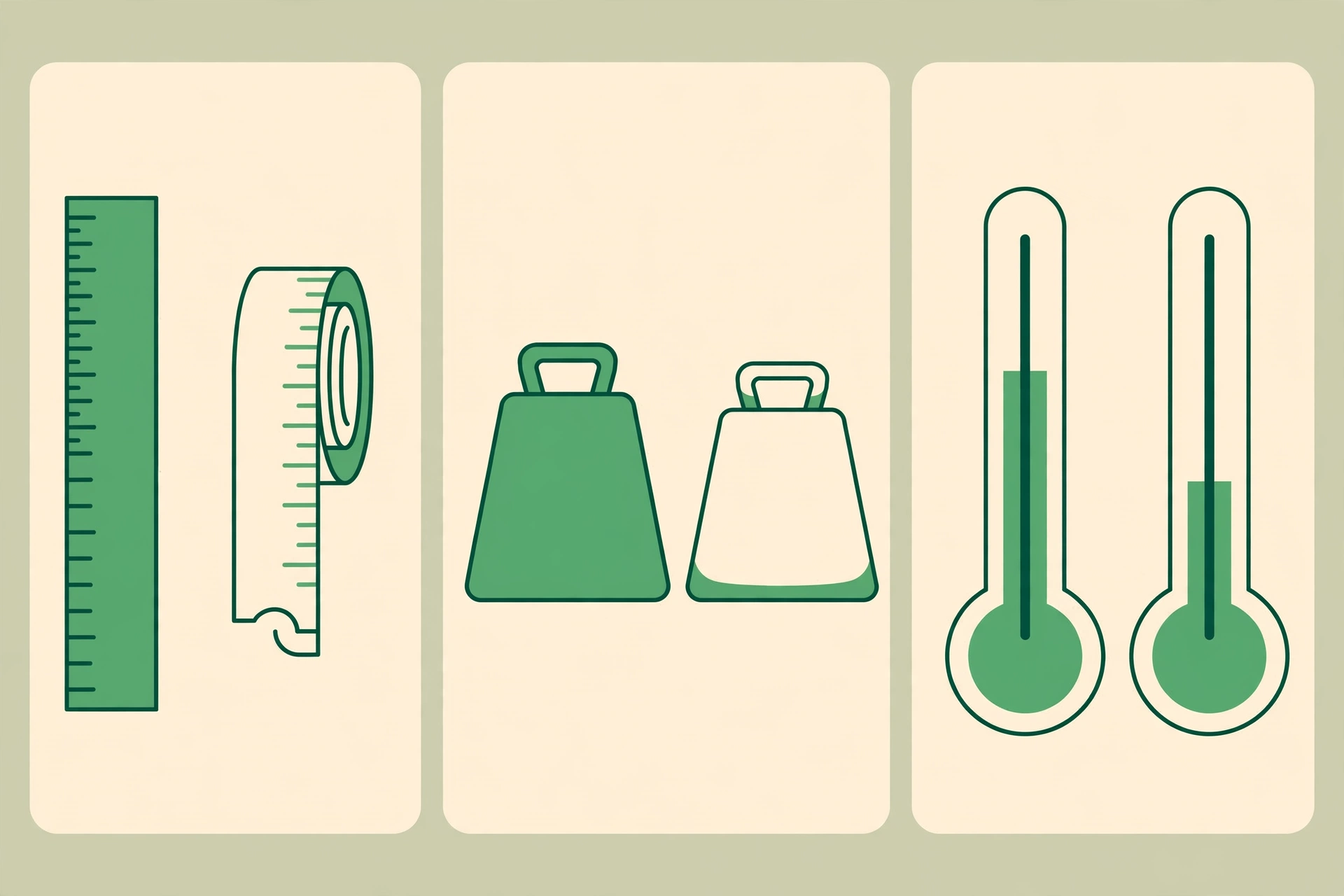
Metric vs Imperial Overview
The metric system (SI) was born in revolutionary France and is today defined by universal physical constants. Its elegance comes from decimal prefixes: milli-, centi-, and kilo- scale units by powers of ten, so converting is just moving a decimal point. The meter, kilogram, and liter form its backbone, and the International Bureau of Weights and Measures maintains the official SI definitions at bipm.org.
The imperial system grew organically from medieval English trade measures. The foot was literally a foot, the pound descended from the Roman libra, and its units relate by irregular ratios: 12 inches to a foot, 16 ounces to a pound, 8 pints to a gallon. That irregularity makes mental conversion harder, but it gives human-scale units many people find intuitive.
In the metric vs imperial contest, metric has won globally: more than 95 percent of the world’s population lives in countries that use it officially. Yet imperial endures in American daily life, British road signs, and aviation altitudes worldwide. The practical skill is not choosing a side in the metric vs imperial debate but converting fluently between both.
The metric system itself was modernized in 2019, when the kilogram, ampere, kelvin, and mole were redefined in terms of fundamental constants of nature rather than physical artifacts. This change, overseen by the BIPM, anchors the metric system to unchanging properties of the universe. The imperial system has no such governing body; in the United States its units are legally defined by their exact metric equivalents, a quiet admission of which system truly underpins modern measurement.
Length Conversions
Length is where metric vs imperial confusion strikes most often. Heights, room dimensions, and road distances all cross systems, so these exact factors are worth memorizing:
- 1 inch = 2.54 cm (exactly)
- 1 foot = 30.48 cm = 0.3048 m
- 1 yard = 0.9144 m
- 1 mile = 1.609 km
- 1 cm = 0.3937 inch
- 1 m = 3.281 ft = 1.094 yards
- 1 km = 0.6214 mile
Worked example: 5 feet 10 inches is 70 inches, and 70 × 2.54 = 177.8 cm. For road trips, remember 1 mile ≈ 1.6 km, so a 100-mile drive is about 161 km. The National Institute of Standards and Technology defines these exact conversion factors at nist.gov, the U.S. authority on measurement.
Weight Conversions
Weight (technically mass) conversions matter for cooking, fitness, luggage, and shipping in the metric vs imperial world:
- 1 ounce = 28.35 g
- 1 pound = 0.4536 kg
- 1 stone = 6.350 kg (UK)
- 1 US ton = 907.2 kg; 1 metric tonne = 1000 kg
- 1 kg = 2.2046 lb
- 1 g = 0.03527 oz
Worked example: 180 lb × 0.4536 = 81.65 kg. A stick of butter (4 oz) is 113 g. Watch out for the ton versus tonne trap: a US ton is about 10 percent lighter than a metric tonne, a difference that matters enormously in freight and engineering.
Temperature Conversions
Temperature is the trickiest metric vs imperial conversion because it needs a formula, not just multiplication:
- °C = (°F − 32) × 5/9
- °F = °C × 9/5 + 32
- Kelvin = °C + 273.15
Memorize the landmarks: 32°F = 0°C (freezing), 68°F = 20°C (room temperature), 98.6°F = 37°C (body temperature), 212°F = 100°C (boiling). For weather, use the quick trick: double the Celsius figure and add 30 for approximate Fahrenheit. So 20°C becomes roughly 70°F, close to the true 68°F — good enough for deciding what to wear.
Which Countries Use What
Only three countries have not officially adopted the metric system: the United States, Liberia, and Myanmar. Everyone else uses metric as the official standard, although the United Kingdom mixes both systems (miles on road signs, pints in pubs, metric almost everywhere else).
The United States actually tried to switch. The Metric Conversion Act of 1975 made metric voluntary, and American science, medicine, and the military went metric while daily life did not. NASA now uses metric exclusively after the infamous 1999 loss of the Mars Climate Orbiter, caused by a metric vs imperial unit mix-up between engineering teams.
Global industries pick sides pragmatically: aviation uses feet for altitude worldwide, shipping measures cargo in metric tonnes, and car manufacturing is overwhelmingly metric. Travelers benefit most from metric vs imperial fluency, since a single trip can span speed limits in km/h, fuel in liters, and hotel room sizes in square feet.
Quick Conversion Tricks
Memorize these mental shortcuts for everyday metric vs imperial estimates:
- Inches to cm: multiply by 2.5, then add a touch.
- Miles to km: multiply by 1.6.
- Pounds to kg: divide by 2.2 (or halve, then subtract 10 percent).
- Fahrenheit to Celsius (weather): subtract 30, then halve.
- US gallons to liters: multiply by 3.8 — but check whether you mean a UK gallon (4.55 L).
Volume deserves special attention in metric vs imperial cooking conversions: 1 US fluid ounce = 29.57 ml, 1 US cup = 236.6 ml, 1 US pint = 473.2 ml, 1 US quart = 946.4 ml, and 1 US gallon = 3.785 L. Every UK version is about 20 percent larger, so always confirm which gallon, pint, or cup your source means before you scale a recipe.
These tricks land within a few percent, plenty for cooking, travel, and shopping. For engineering, medicine, or anything involving money, always use the exact factors — or run the numbers through our free unit converter to eliminate arithmetic slips.
Common Mistakes
Avoid these classic metric vs imperial errors:
- Confusing US and UK gallons or pints: they differ by about 20 percent.
- Using ton and tonne interchangeably: a US ton is 907 kg, a metric tonne is 1000 kg.
- Forgetting temperature needs a formula, not a simple ratio.
- Rounding conversion factors too early in multi-step calculations.
- Assuming an ounce of weight equals a fluid ounce: fluid ounces measure volume and differ by liquid density.
- Mixing systems mid-project, the Mars Orbiter lesson: pick one system per calculation and convert inputs first.
Frequently Asked Questions
What is the main difference between metric and imperial?
Metric is decimal-based (powers of ten) and globally standard; imperial uses irregular ratios such as 12 inches to a foot and persists mainly in the United States. The metric vs imperial choice rarely matters as long as you convert correctly.
Which countries still use the imperial system?
The United States, Liberia, and Myanmar have not officially adopted the metric system. The United Kingdom uses a mix of both systems in daily life.
How do I convert inches to centimeters?
Multiply inches by 2.54 exactly. So 10 inches = 25.4 cm, and 5 feet 10 inches = 177.8 cm.
How do I convert pounds to kilograms?
Multiply pounds by 0.4536. So 150 lb = 68.04 kg, and 1 kg = 2.2046 lb going the other way.
What is 20 degrees Celsius in Fahrenheit?
20 × 9/5 + 32 = 68°F, a pleasant room temperature and one of the most useful metric vs imperial landmarks to memorize.
Why did the United States never switch to metric?
The 1975 Metric Conversion Act made conversion voluntary, and cultural inertia plus conversion costs kept imperial in daily life, even though American science, medicine, and the military largely operate in metric.
Is a UK pint the same as a US pint?
No. A UK pint is 568 ml while a US pint is 473 ml, about 20 percent smaller. Always check which pint a recipe or pub means before converting.
What is the easiest tool for unit conversions?
An online unit converter. Try ours for instant metric vs imperial results across length, weight, volume, and temperature without any mental math.
Key Takeaways
- Metric is decimal and global; imperial is traditional and mainly American.
- Memorize the exact anchors: 1 in = 2.54 cm, 1 lb = 0.4536 kg, 1 mile = 1.609 km.
- Temperature needs formulas: °C = (°F − 32) × 5/9.
- Watch US vs UK gallons and pints, and ton vs tonne.
- Only the US, Liberia, and Myanmar remain officially non-metric.
- Use exact factors for critical work and mental tricks for quick estimates.
Final Thoughts
The metric vs imperial divide is really a translation problem, and like any language, fluency comes from practice. Learn the handful of exact factors, keep the mental shortcuts in your pocket, and double-check units whenever money, safety, or science is on the line. Keep a short list of the exact factors on your phone, and you will never be caught out by an unfamiliar unit again.
Convert anything instantly with the free unit converter on CalcWise, and explore more practical tools on the CalcWise homepage. In a world that runs on both systems, the person who speaks metric vs imperial fluently has a genuine edge.