Compound Interest Calculator
Our free compound interest calculator projects how your money grows when earnings are reinvested. Enter your initial deposit, monthly contribution, expected annual return, and time horizon.
Compound Interest Calculator
See how savings and investments grow with compound interest and monthly contributions.
Your result
Formula
Future value = lump sum grown at (1+r)^years, plus each monthly contribution compounded for the months remaining.
How to use this calculator
Enter what you start with, what you add each month, the expected annual return and the time horizon.
Worked example
Example: €10,000 plus €200/month at 7% for 20 years grows to about €142,882 — most of it from compounding, not contributions.
Frequently asked questions
Compound Interest Calculator
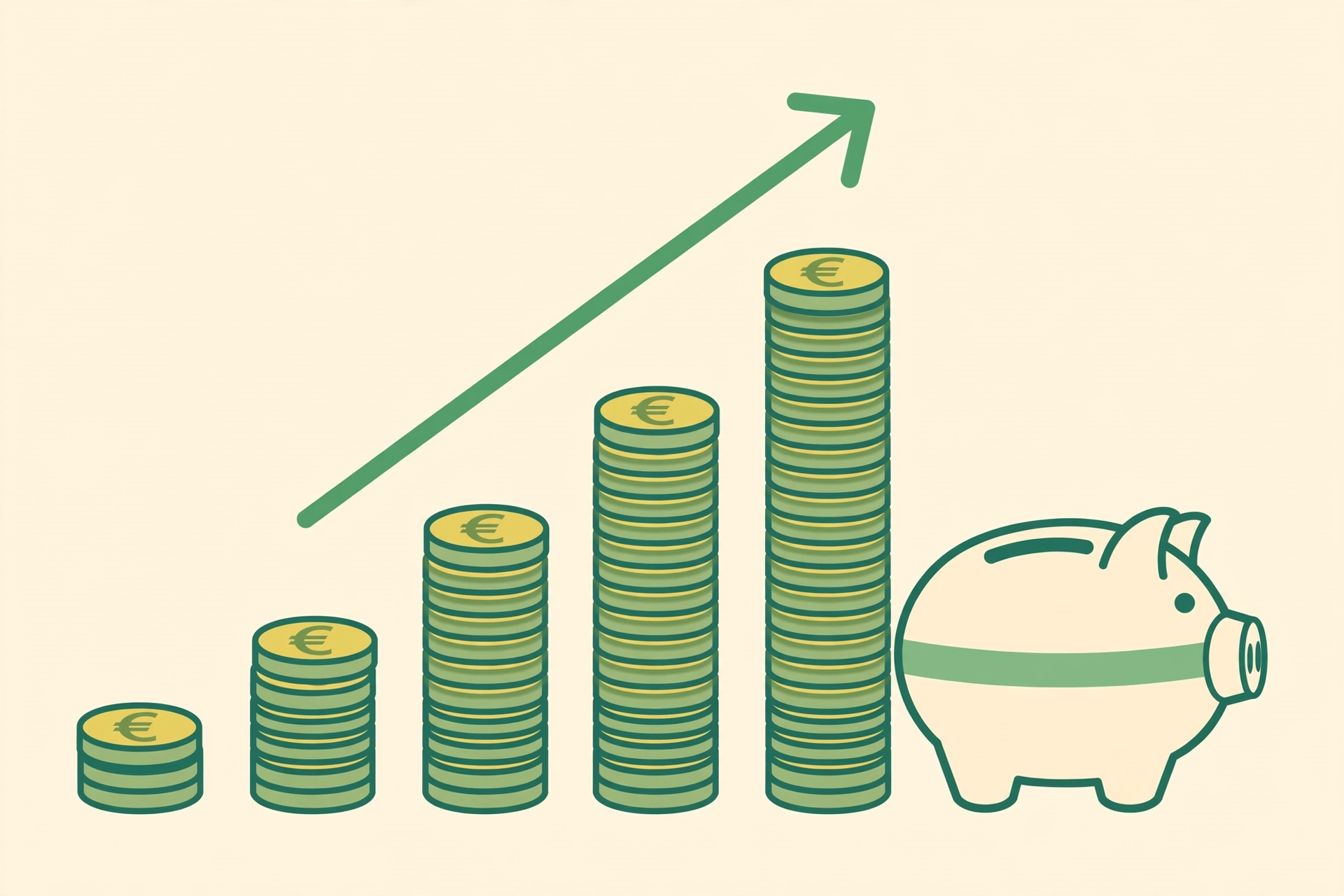
Start with your initial lump sum. Add your planned monthly contribution. Enter a realistic annual return. Set your time horizon. The compound interest calculator instantly reveals your projected balance.
How This Compound Interest Calculator Works
This compound interest calculator applies the principle that makes wealth grow exponentially: returns earned in one period generate their own returns in the next. Each month, your balance grows by the assumed rate, and the following month’s growth is calculated on the larger amount.
Your initial deposit compounds for the full time horizon, while each monthly contribution compounds for the months remaining after it is added. The calculator sums all of these growing amounts to project your final balance, showing how much came from your contributions versus growth.
Because the math runs instantly in your browser, you can compare scenarios side by side — starting five years earlier, adding €100 more monthly, or assuming a slightly higher return — and see which change matters most. No data leaves your device.
How to Use the Compound Interest Calculator
Using the compound interest calculator takes seconds. Enter your starting amount — what you can invest today as a lump sum. If you’re starting from zero, enter 0; the monthly contributions will do the heavy lifting.
Next, input your planned monthly contribution: the amount you’ll add regularly. Then enter your expected annual return as a percentage — be realistic (6–8% for diversified stock portfolios historically, 1–3% for savings accounts).
Finally, set your time horizon in years. The calculator instantly shows your projected balance, total contributions, and total growth. Adjust any input to see how sensitive the outcome is to time, rate, and contribution size.
Compound Interest Formula Explained
The compound interest calculator uses the formula A = P(1+r)^t for lump sums, where A is the final amount, P is the principal, r is the rate per period, and t is the number of periods. Monthly contributions use the future value of an annuity formula, with each payment compounding for its remaining time.
For example, €10,000 at 7% annual return for 20 years grows to about €38,700 — nearly quadrupling without any additions. Add €200 monthly and the total reaches roughly €142,900, with only €58,000 contributed and €84,900 from compounding.
Compounding frequency matters: monthly compounding (used here) slightly outperforms annual compounding at the same nominal rate. The SEC’s investor education site explains how compounding builds wealth over time.
The Power of Starting Early
Time is the most powerful input in the compound interest calculator — more influential than the rate or even the amount. Consider Anna and Ben: Anna invests €300 monthly from age 25 to 35 (10 years, €36,000 total) then stops, letting it grow until 65. Ben waits until 35, then invests €300 monthly for 30 years (€108,000 total).
At 7% annual return, Anna’s early start wins: her €36,000 grows to roughly €540,000 by 65, while Ben’s €108,000 reaches only about €367,000. Anna contributed one-third as much but ended with nearly 50% more — purely because her money compounded longer.
The lesson: every year you delay costs disproportionately. Even small amounts started early outperform larger amounts started late. Run the numbers yourself above — then start today, not next year.
Common Compounding Mistakes to Avoid
The compound interest calculator assumes steady returns, but real investors sabotage compounding. The biggest mistake is withdrawing early: cashing out resets the clock and forfeits the exponential phase where growth accelerates most.
Second, chasing returns by switching strategies constantly. Market timing usually underperforms steady investing; the best return is the one you actually capture by staying invested. Third, ignoring fees — a 1% annual fee can consume nearly a third of returns over 30 years.
Fourth, using unrealistic return assumptions. Projecting 12% forever leads to disappointment; base plans on 6–8% for equities, less for bonds. Finally, neglecting inflation: 7% nominal with 3% inflation is only 4% real growth. Always think in real terms.
Compound Interest Calculator: Tax Considerations
Taxes significantly affect what the compound interest calculator projects versus what you keep. In taxable accounts, dividends and realized gains are taxed yearly, dragging on compounding. Tax-advantaged accounts (pensions, ISAs, 401(k)s) let growth compound untaxed until withdrawal.
Asset location matters: hold tax-inefficient investments (bonds, REITs) in tax-sheltered accounts and tax-efficient ones (stock index funds) in taxable accounts when you must choose. Understand your country’s capital gains rates and annual allowances.
The European Central Bank notes that tax policy shapes savings behavior across the EU. Model your projections on an after-tax basis for honest planning — a 7% pre-tax return might be 5% after tax, which changes the outcome dramatically over decades.
Behavioral Tips for Successful Compounding
Knowing the compound interest calculator math is easy; sticking with it for decades is hard. Automate everything: set up monthly transfers the day after payday so you never see the money to spend it. Automation beats willpower every time.
Increase contributions with raises — save half of every pay increase and you won’t feel deprived while your investing accelerates. Avoid checking balances daily; volatility tempts panic selling, while compounding rewards patience.
Have a written plan for market drops: decide in advance that you will keep buying (or at least hold) when prices fall 20%. Rebalance yearly to maintain your target allocation. And celebrate milestones — every €10,000 is proof the system works.
Compound Interest Calculator FAQ
What is a realistic annual return to assume? For diversified stock portfolios, 6–8% nominal (4–6% after inflation) is reasonable for long horizons based on historical data. Use lower figures for shorter periods or conservative portfolios. The compound interest calculator lets you test multiple scenarios.
How often is interest compounded? This calculator compounds monthly, matching most investment projections. More frequent compounding (daily vs monthly) makes only a tiny difference; the rate and time matter far more.
Does the calculator account for inflation? No — projections are in nominal terms. To estimate real purchasing power, subtract expected inflation (e.g., 2–3%) from your assumed return, or mentally discount the final figure.
What about taxes and fees? The projection is before taxes and fees. For a realistic plan, reduce your assumed return by your expected tax drag and fund expense ratios — often 1–2% combined.
Can I add irregular lump sums? Model them by increasing a single year’s monthly contributions, or run separate calculations for each lump sum and add the results. The key inputs remain time, rate, and amount.
Is compound interest guaranteed? No. Market returns vary yearly and can be negative. The calculator shows a smooth projection; reality will zigzag around it. Diversification and long horizons manage this risk.
Should I pay debt or invest? Compare rates: if your debt costs 8% and expected investment returns are 7%, paying debt wins risk-free. High-interest debt almost always beats investing. Low-rate mortgages are the main exception.
When should I start? Now. As the Anna vs Ben example shows, time matters more than amount. Even €50 monthly started today beats €200 monthly started in ten years.
Compound Interest Calculator: Real-World Case Studies
Beyond theory, the compound interest calculator illuminates real decisions. Take Maria, 30, who invests €500 monthly at 7% until 65: she contributes €210,000 and ends with roughly €1.2 million. Her colleague Jonas starts at 40 with the same €500 monthly: he contributes €150,000 but reaches only about €610,000. Maria’s ten-year head start — costing her just €60,000 more in contributions — yields nearly double the final balance.
Or consider the impact of fees. Two investors each contribute €400 monthly for 30 years at 7% gross return. One pays 0.2% in fund fees (net 6.8%), the other 1.2% (net 5.8%). The low-fee investor ends with about €585,000; the high-fee investor with only €465,000 — a €120,000 gap from a single percentage point. Small differences compound just like returns do.
These cases show why the calculator’s inputs deserve care: start date, contribution size, realistic return net of fees, and time horizon interact powerfully. Model your own situation above, then protect the plan from the silent wealth-killers: delay, high fees, and early withdrawals.
Key Takeaways
A compound interest calculator shows that time, consistent contributions, and realistic returns build wealth exponentially. Start early, automate monthly investing, keep fees and taxes low, and let compounding work for decades.
For mortgage planning alongside investing, try our mortgage calculator to compare borrowing costs against investment growth.
Final Thoughts on Compound Growth
Your compound interest calculator projection is a map, not a promise — but it’s the best map available. The investors who build real wealth aren’t those who pick perfect stocks; they’re those who start early, contribute consistently, and never interrupt compounding.
Run your numbers above, set up that automatic transfer, and then get on with your life. Decades from now, your future self will thank you for the boring, brilliant decision to let time do the heavy lifting.
Bookmark this compound interest calculator and revisit it yearly as your income grows. Small increases to your monthly contribution compound powerfully over decades.